
STORIES > INDONESIA > YOGYAKARTA > ARTICLE
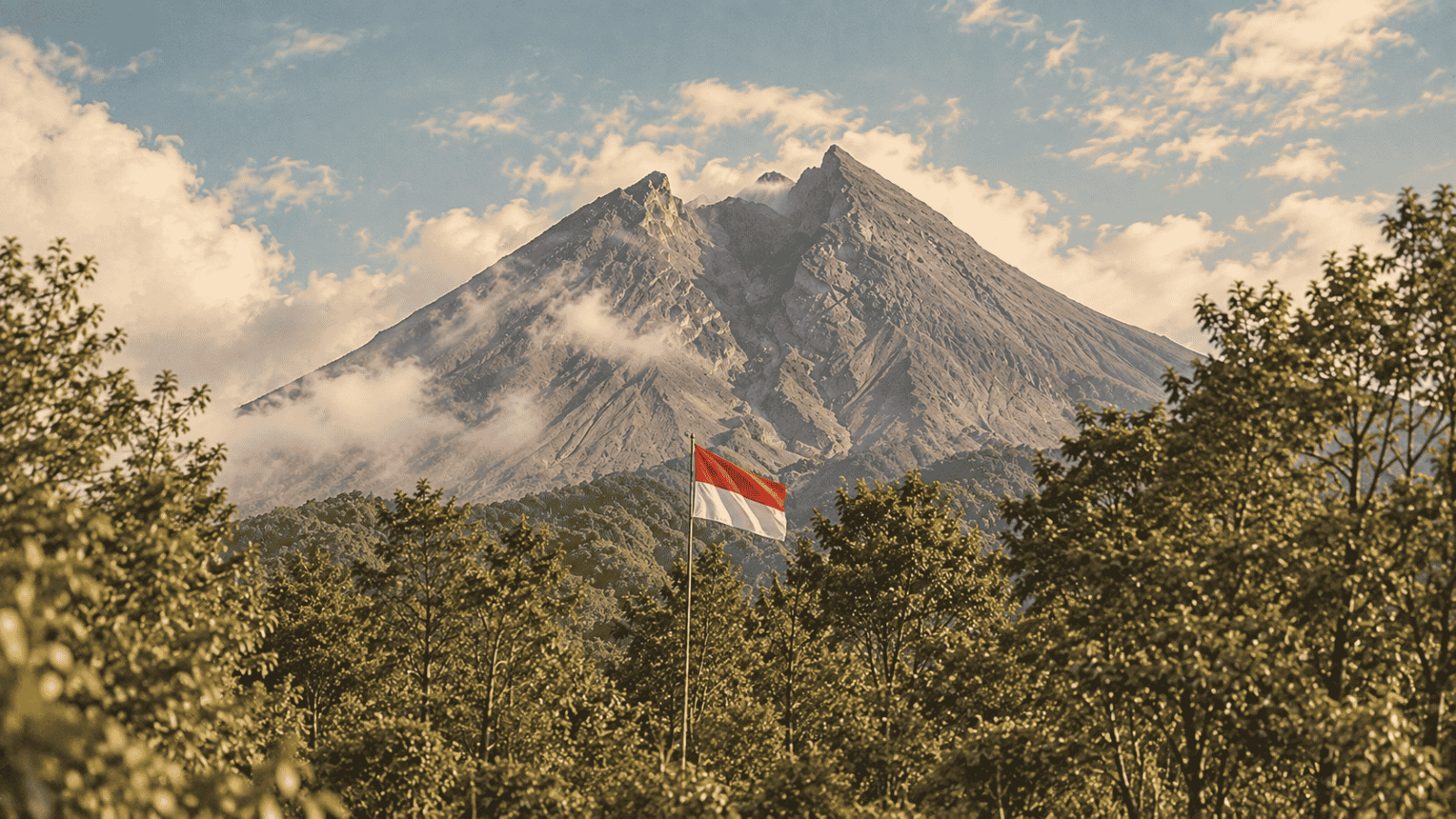
MERAPI VOLCANO AND JAVANESE MORALITY
How Mount Merapi shapes Yogyakarta’s spiritual landscape, anchor of the Philosophical Axis, and guide to Javanese morality.
The old man never saw pyroclastic flows as deadly monsters. To Mas Asih, the billowing grey clouds rising from Mount Merapi's peak—dubbed wedhus gembel (shaggy goat) by the media due to their resemblance to sheep's wool—were simply the mountain's way of sweeping its own front yard.
I first sat with Mas Asih several years ago, when I was working for a travel magazine based in Yogyakarta. Our conversation took place in Kinahrejo, on the southern slopes of Merapi, and I kept the raw interview material from that day. Revisiting those notes now, I found myself hearing his words differently—not simply as memories of an encounter, but as a way of looking again at Merapi, Yogyakarta, and the Javanese relationship with the mountain. This essay grows from that earlier conversation, revisited from the distance of time.
"If your home is dirty, you sweep it, don't you?" he said casually, lighting a klobot (corn husk) cigarette. Thin smoke drifted upward, merging with the mist creeping over Kinahrejo Hamlet on Merapi's southern slope. "That ash isn't garbage. It is Merapi's way of sharing the most fertile fertilizer for its descendants ten years from now."
I sat on the veranda of his modest home. In a modern world obsessed with insurance guarantees, earthquake-proof buildings, and weather forecast apps, this perspective seemed almost crazy. We are taught to fear risk and run as fast as we can when the earth shakes. Yet here, 15 kilometers from a crater that never truly sleeps, death and fertility are not opposing forces. They are a pair of lovers walking hand in hand.
Merapi does not merely stretch across the landscape as a geological anchor in the middle of Java Island. It is the primary author of the moral code, the determinant of the social compass, and a spiritual teacher for the people of Yogyakarta.
The Philosophical Axis: A Geometrical Masterpiece by Sri Sultan Hamengku Buwono I
To understand Yogyakarta, you must be guided by a straight 15-kilometer line bisecting the city from north to south. This is no coincidence of modern urban planning, but rather The Philosophical Axis of Yogyakarta (Sumbu Filosofi), a stroke of cosmological genius conceived by the founder of the Yogyakarta Sultanate, Sri Sultan Hamengku Buwono I, in 1755.
In the design of Prince Mangkubumi (Sultan HB I's title before ascending the throne), the city was built upon an imaginary line connecting three primary spiritual nodes: Mount Merapi at the northern tip, the Kraton (Palace) in the center, and the South Sea (Parangkusumo Coast) at the southern tip.
Merapi symbolizes the fire element, the masculine spirit (Purusa), and the origin of life (Hargo Dumadi). The South Sea symbolizes the water element, the feminine spirit (Prakriti), and the place of return. Meanwhile, the Kraton inhabited by the Sultan sits in the middle as a harmonious balancing point between the mortal realm and supernatural forces.
This straight line symbolizes the spiritual journey of Javanese humanity: Sangkan Paraning Dumadi—where human beings originate and where they shall return. The path moving from the south toward the palace represents the process of conception and birth (from Panggung Krapyak to the Kraton), while the path from the north toward the palace depicts the journey of returning to the Creator by cleansing earthly desires.
For the residents of Yogyakarta, Merapi’s presence at the end of this sacred line ensures the mountain is never viewed as an alien object outside the city. Merapi is the source of their origin and life.
The Loss of 'Left and Right': Cardinal Navigation and the Inner Compass
The deep connection between the people of Jogja and Merapi has given birth to a unique cultural phenomenon that often confuses visitors from outside Java: a navigation system based on cardinal directions.
If you get lost in Jakarta, Bandung, or Medan and ask a local for directions, they will say: "Turn right at the intersection, then turn left at the convenience store."
In Yogyakarta, however, such directions rarely apply. A local will casually say: "Go straight north at the intersection. Once you reach the bangjo (traffic light), turn east for about 100 meters; the house is on the south side of the road."
This orientation does not depend on your body's relative position, but on an eternal geological benchmark. Mount Merapi serves as the absolute point for North (Ngalor), while the South Sea serves as the absolute point for South (Ngidul). East (Ngetan) and West (Ngulon) are adjusted accordingly. Even a young child in Jogja is trained to always know where Merapi is located, even when obscured by tall buildings or shrouded in pitch-black night.
In Javanese culture, losing one's cardinal sense is not just a technical issue of getting lost on the road; it is a moral metaphor. There is a popular Javanese saying: "Kowe ki lakune wis ra cetha, ra ngerti ngalor-ngidul" (Your path is no longer clear; you don't know north from south). Someone who has lost their ethics, is tossed about by moral confusion, or has forgotten their roots is said to have lost their Ngalor-Ngidul direction. Merapi stands as an eternal reminder for the community never to lose its inner compass.
Mythology, Songs, and Merapi's Shadow in Javanese Literature
This harmonious relationship was etched long before seismograph technology existed. In ancient palm-leaf manuscripts (lontar) and royal chronicles—such as the Serat Centhini and Babad Tanah Jawa—Merapi is never portrayed as a malicious entity.
In wayang mythology and Javanese folklore, the mountain range was said to be created when the gods relocated Mount Jamurdipa to balance the island of Java so it would not tilt. Behind its smoldering crater, it is believed there lies a hidden "Unseen Realm" ruled by guardian figures like Eyang Merapi, Kyai Petruk, and Nyai Gadung Melati, whose duties are to protect the vegetation and manage the winds.
Even in Dolanan Bocah (traditional children's games), traces of reverence for Merapi are embedded in oral songs sung under the moonlight. Children sing simple verses teaching them to respect the whispers of the wind and the tremors of the earth coming from the north, conditioning their mindsets early on so they do not curse nature when it surges.
In Javanese oral traditions and contemporary macapat gatherings, Merapi has often been approached not merely as a physical force but as a source of pepeling—a reminder to remain eling lan waspada, mindful and watchful. Its eruptions can become metaphors for human vulnerability, humility, and the limits of human control.
The 2010 Tragedy: A Bitter Lesson on Scorched Earth
However, this cultural harmony was tested to its darkest point in modern Yogyakarta's history: the major eruptions of October–November 2010.
Before 2010, residents living on the slopes of Merapi were accustomed to 'effusive' eruptions—a slow growth of lava domes that eventually collapsed to form pyroclastic flows with relatively predictable runout distances (around 4 to 8 km). They felt they understood the mountain's behavior. Mbah Maridjan, the legendary gatekeeper (Juru Kunci) at the time, became a symbol of local resilience, refusing to evacuate because he felt he had not yet received the spiritual 'whispers' or natural signs signaling him to descend.
Yet in 2010, Merapi decided to drastically change the rules of the game. The eruption became 'explosive'—the largest in 100 years.
On the grim night of October 26, 2010, pyroclastic flows traveling at over 300 kilometers per hour with temperatures reaching 600 degrees Celsius swept through Kinahrejo Hamlet. Mbah Maridjan perished in a prostrate prayer position inside his home, along with dozens of residents who had stayed behind. It did not stop there; at the peak of the eruption on November 5, 2010, the danger zone was expanded to a 20-kilometer radius from the summit. Yogyakarta was blanketed in thick volcanic ash that paralyzed activity and turned day into night. Over 350 lives were lost, and hundreds of thousands were displaced.
It was a devastating human tragedy that struck deeply at the heart of Javanese identity. Pride in ilmu titen (the traditional practice of reading natural signs) seemed shattered by unpredictable magmatic explosions.
"The year 2010 was a harsh slap in the face for all of us," recalled Mas Asih, his eyes gazing into the distance. His father had passed away in the event, leaving him with the heavy responsibility of succeeding him as gatekeeper. "We realized that loving Merapi does not mean assuming we know more than the mountain itself. Mbah Maridjan showed devotion to his duty, but the lesson for us who live on is this: science and tradition must walk side by side, not challenge one another."
Modern Mitigation Learning: Synergy Between BPPTKG and Community Readiness
The 2010 tragedy marked a dramatic turning point in disaster management history in Indonesia. Since that day, the approach to mitigation on Merapi's slopes was completely overhauled through a close integration of advanced technology and local wisdom.
At the office of the Center for Volcanology and Geological Hazard Mitigation (BPPTKG) in Yogyakarta, Merapi's dynamics are now monitored through hundreds of high-precision sensors. Seismometers are installed around the crater rim, thermal cameras track lava dome growth 24 hours a day, GPS and tiltmeter instruments measure deformation down to the millimeter scale, and specialized drones are flown periodically to map volcanic material volumes.
However, this technological sophistication is no longer isolated inside laboratory walls. BPPTKG and the Regional Disaster Management Agency (BPBD) built a system directly interwoven with the pulse of local life:
Sister Village System (Sistem Warga Bersaudara): Villages in high-risk zones (KRB III) on the upper slopes are permanently paired with safe-zone villages on the lower slopes. If Merapi's status steps up to 'Warning', residents of Glagaharjo Hamlet already know precisely whose house in Sinduharjo Village they will evacuate to. Evacuation routes, logistics, and livestock shelters are arranged before a disaster strikes.
Community Outposts & Communication Radios: Local residents established volunteer networks like JALIN Merapi. Every BPPTKG observation post connects directly via VHF/UHF radio to handheld radios owned by villagers, livestock farmers, and sand-truck drivers. Technical scientific data, such as "an increase in multi-phase earthquake frequency," is translated in real-time into practical ground-level instructions.
Cultural Integration in Mitigation: Scientific authorities now collaborate with traditional figures. When BPPTKG issues a 5-kilometer safety recommendation, Mas Asih as the Gatekeeper reinforces the advice to traditional communities: "Science has given us the signal; Merapi is hosting a gathering. Let us grant space for the mountain to put its house in order."
The results are tangible. When Merapi entered another prolonged eruptive phase from 2018 up to the present day (including the 2021–2023 effusive dome lava eruptions), no casualties were reported among local residents. Evacuations took place in an orderly manner without mass panic. People moved not out of fear, but out of understanding.
Labuhan Merapi: A Ritual to Tame Human Ego
One of the most crucial events in maintaining cosmological harmony is the execution of the Labuhan Merapi ceremony.
Held annually on the 30th of Rejeb in the Javanese calendar (marking the commemoration of the Sultan's accession to the throne), this ritual is led directly by the Gatekeeper under official royal decree from the Kraton of Yogyakarta.
Early in the morning, a procession of Kraton courtiers (abdi dalem) clad in traditional pranakan attire marches through the mountain slope forests toward Bangsal Sri Manganti—a ritual post situated around 1,500 meters above sea level. They carry jodang (wooden crates) containing Ubarampe (ritual offerings) sent directly by the Sultan from the Palace.
The Ubarampe includes:
Kain Banguntulak: Dark blue fabric with spiritual significance used to ward off misfortune.
Sultan's Clothes (Uwet): Used clothing belonging to the Sultan.
Nail Clippings & Hair (Lorodan): Trimmings from the Sultan.
Offerings (Pahargyan): Fragrances, assortment of flowers, and ceremonial food.
After interfaith prayers for protection are offered—combining verses of the Quran with ancient Javanese chants—these ritual items are buried or released into the soil of Merapi.
To an unfamiliar tourist, Labuhan might be misinterpreted as a practice of feeding the mountain. To the Javanese, however, it carries profound psychological, political, and ecological meaning.
By surrendering the most personal belongings of the King—the figure holding the ultimate political and economic authority in Jogja—the Kraton performs an act of purifying the ego. It serves as a symbolic message that before the majesty of God and the raw power of the universe, a king's throne, worldly wealth, and human pride mean nothing.
Labuhan is an annual ceremony of bowing one's head. It teaches that humans must not greedily exploit nature, but rather share it respectfully with all creation.
Absorbing Lessons from the Great Teacher
Late afternoon shadows lengthen over the southern slope. Mount Merapi’s sharp summit is slowly swallowed by thick rolling mist, hiding the thin solfatara smoke rising continuously from its crater. The city of Yogyakarta down below begins to illuminate its streetlights. Traffic hums along main thoroughfares, young people gather in trendy cafes, and economic life moves forward without pause.
Yet beneath the lively glow of this warm and welcoming city, there lies the steady heartbeat of a giant pulsing 15 kilometers to the north.
The people of Yogyakarta never truly forget Merapi. The mountain is present in every breath of their culture: in the carved motifs of home architecture, in the movements of the sacred Bedhaya Ketawang dance inside the Palace, in traditional karawitan melodies, and in the gentle way neighbors greet each other along the roadside—a softness that conceals resilience as tough as steel.
Merapi's repeated eruptions have forged incredible resilience in the people of Jogja. They have lost homes, livestock, and fields time and again, yet they consistently rebuild their lives atop the warm volcanic ash.
They have learned a secret of life rarely understood by modern society: that suffering and blessing, death and fertility, are part of a single unified cycle to be accepted with grace (ikhlas).
Before taking leave from Kinahrejo, I asked Mas Asih one final question: "Are you ever afraid that one day Merapi might erupt even more violently?"
He smiled faintly, adjusting his silvering Javanese blangkon headpiece. His eyes gazed softly toward the fog veiling the mountain peak.
"Fear only arises when we feel we own things," he replied gently in Indonesian, accented with a rich Javanese cadence. "This land belongs to God (Gusti Allah). Merapi is His instrument to shape the earth. We are merely taking shelter here—seeking temporary refuge from the rain. If the owner of the house wishes to clean up or rearrange the furniture, why should we, who are merely guests, be angry?"
I walked down the winding road away from the slopes of Merapi with a newfound clarity. The mountain never intends to destroy; it is simply teaching.
Amidst a modern world growing increasingly arrogant, greedy, and rushed, Merapi stands firm at the end of the Philosophical Axis as an eternal moral guide. It whispers an ancient, crystalline message to anyone willing to listen: know your limits, respect your nature, humble your ego, and always remember the true direction to which your steps will return.
CONTRIBUTOR / STORY AUTHOR
DETI LUCARA
WWC-26-000010Yogyakarta, Indonesia
Travel writer and founder of Where We Crossed, documenting places, people, and stories through slow travel.
COMMENTS & REFLECTIONS
0 Comment(s)WANT TO JOIN THE CONVERSATION?
Sign in with your member passport to share your reflections on this archive.
No reflections recorded yet. Be the first to share your thoughts on this story.